
Lately,
Welcome! Here, you'll find updates about what I've been up to lately. Stay tuned for the latest adventures and reflections!

An Afternoon in Cross Creek.
Down winding country roads, under a moss canopy exists: Cross Creek, a gem of Old Florida Charm. A place where the orange groves still flourish and time seems to slow.
By: Brenda Medrano

"Cross Creek belongs to the wind and the rain, to the sun and seasons, to the cosmic secrecy of seed, and beyond all, to time." - Marjorie Kinnan Rawlings, 1983.

CROSS CREEK
I traveled to the past, to a place where time seems to slow and the orange groves still thrive. It's named Cross Creek, and it exists, unassumingly, in North Central Florida, just 15 miles outside of my hometown of Gainesville.
I visited in January, feeling inspired by the writings of American Author, Marjorie Kinnan-Rawlings, known for her classic novels, The Yearling (1938) and Cross Creek (1942). I recently found a first-edition copy of her book Cross Creek, and wanted to see for myself, this rural town that she described so lovingly in her writings.
In 1928, Marjorie Kinnan-Rawlings used her inheritance to buy 72 acres of land in Florida's North-Central Region. The area is remote, swampy, and wild. However, its lack of inhabitants is compensated by its unspoiled natural beauty. The cracker-style home and farm, where Marjorie spent a good portion of her life living and working, is now restored and preserved in a state park and remains as Marjorie had lived in it.
THE PROPERTY

I followed a footpath through a rusted gate under a canopy of sturdy orange trees. Beyond it, was an open grassy yard that was empty, except for a few chickens roaming around. However, as I stumbled upon the old wooden work shed, I found the park keeper inside—a friendly man with overalls and a grand beard. He greeted us warmly, welcoming us to her home.
As the park keeper rummaged through a bale of hay stacked along the wall, and he shared that had been maintaining the grounds for approximately two years. Unfortunately, since I visited on a Tuesday, the interior of the home was not available for tours. However, he gave me a map and encouraged me to explore.

The first thing to notice, is a model of Marjorie's 1930s car parked under an open carport beside the house. The front door is situated behind a large wraparound porch, where Marjorie could often be found cleaning her shotgun. Perhaps on on other other days- hunkered down during a true Florida storm.
Though I couldn't enter, peering through the screened windows gave me a vision into what life would have been like for Marjorie. The foyer resembled a classic Florida room with high ceilings designed to vent hot air, a ceiling fan, and large windows to let in a refreshing breeze. Everything was made of wood—wooden floors, rafters, a desk, and a chair.



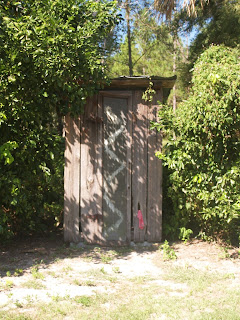
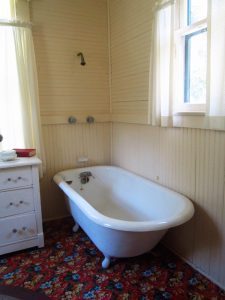
Preserved on the property is also the outhouse, of which the park keeper stated Marjorie often lamented that she hated, not just for the impractiality, but the look. So much so that any time she had guests, she would place herself at the head of the table, across from the window that overlooked her yard and at the eye sore. It makes sense that Marjorie's home was the first in all of cross creek to be fitted with plumbing. And when the renovation was complete in 19__, she invited the towns people over to share in the excitement. She threw a party and filled her new tub, with ice and water, to keep the drinks cold.
But who would Marjorie be hosting so secluded in her area? Some included her friends: Margaret Mitchell and Robert Frost.


MARJORIE
Marjorie Kinnan-Rawling's was a bit of a renegade, herself. She smoke, she drank. But, she was also well educated and a hell-of-a writer. She was born August of 1896, in Washington D.C and later moved to Madison Wisconsin to attend College, receiving her degree in English. After graduating, Marjorie married and moved to New York City, then to Louisville Kentucky. But ultimately, she chose to buy a small piece of land with the inheritance for her mother.

Marjorie made it clear that life wasn't always easy at the Creek. The people could be hot headed- getting into fights over property or alcohol-fueled anger. She was controversial to the locals, even later accused of exploiting thier "cracker" lifestyle for profit. Something Marjorie was sued over in 19_. It should also be highlighted that Marjorie's had a lot of help on her farm. A property of this size, was no small undertaking and many people had come-and-gone to help Marjorie. But, there is one woman, Beatrice, that has a dedicated chapter in Cross Creek.
Marjorie called her GeeChee, as she was of the GeeChee people (a subgroup of the African American ethnic group, who predominantly live in the Lowcountry region of the U.S. states of North Carolina, South Carolina, Georgia, and Florida). About 30 yards from the main home, exist a small wood cabin (approximatly 10x25 feet big), in which GeeChee lived on the farm with her husband, Leroy.

GeeChee had been working for Rawlings intermittently for almost two years. One day, GeeChee confided in Rawlings that her boyfriend, Leroy, was imprisoned for manslaughter and requested assistance in securing his release. Marjorie organized for Leroy to be paroled to her care and to work on her farm, and she hosts a wedding on the premises for Beatrice and Leroy.
Leroy soon demanded more money from Rawlings and threatened her, prompting her to ask him to leave, though she worries about GeeChee leaving too. GeeChee chose to stay initially, but began drinking heavily and eventually left Rawlings. Weeks later, Rawlings found GeeChee and brougt her back, but GeeChee's drinking continued, leading Rawlings to let her go.
In her autobiography, Rawlings reflects, "No maid of perfection—and now I have one—can fill the strange emptiness she left in a remote corner of my heart. I think of her often, and I know she does of me, for she comes once a year to see me."

It's a poignant story with complex conflicts. Although Marjorie had a great deal of love and respect for the local people, she was also a product of her era. While she may have cherished nature and cared for individuals whom society frequently disregards, Viewed from the perspective of 2025, there are many aspects that appear racist, such as the name "GeeChee," the living conditions of her staff, and how they were treated. It's difficult to determine how much of her actions were driven by tolerance versus self-interest.The only person who can define her true intentions is Marjorie, herself. So through the lens of someone like myself, in 2025, I believe it's important to share all angles and accept that there are
FAREWELL

In Kinnan-Rawling's own words:
Cross Creek is a bend in the country road, by land, and the flowing of the Lochloosa Lake into Orange Lake, by water.

At one time or another, most of us as the Creek have been suspected of a degree of madness. Madness is only a variety of mental nonconformity and we are all individuals here.

The earth may be borrowed, not bought, may be used, not owned. It gives itself in response to love and tenderness, offers its seasonal flowering and fruiting.

Brenda Medrano


Be the first to know
Subscribe to our newsletter to receive news and updates.